
Why TOURISM INVESTMENTS?
In 2019, Travel & Tourism’s direct, indirect and induced impact accounted for the following:
- US$8.9 trillion contribution to the world’s GDP
- 10.3% of global GDP
- 330 million jobs, 1 in 10 jobs around the world
- US$1.7 trillion visitor exports (6.8% of total exports, 28.3% of global services exports)
- US$948 billion Capital Investment (4.3% of total investment)
The benefits of Travel & Tourism spread far beyond its direct impacts in terms of GDP and employment, with indirect benefits throughout the Supply Chain and Interlinkages to Other Sectors, such as
- Agriculture,
- Retail,
- Arts & Crafts,
- Transport & Logistics, and
- Construction, among others.

UNWTO data; International Tourist Arrivals reached 1.5 billion in 2019.
UNWTO forecasted (in 2019) that international tourist arrivals could reach 1.8 billion by 2030 which represents around 50 million additional arrivals per year.
Data showed that International Arrivals to African destinations reached 71 million in 2019 and grew by 4%.
INVESTMENT STRATEGIES
SERIES OF INVESTMENT STRATEGIES & POTENTIAL SOLUTIONS
TIDIA will be championing integrated, Progressive Tourism Development & Investment Strategies, including for example the following:
1] Develop coherent, Avant-garde Narratives for the design of tourism developments, supported by Long-term Strategies, and Agile Business Plans.
2] Establish Cooperative Partnerships & Project Collaborations for the success delivery of tourism developments, and the relevant value chains.
3] Create delivery models and structure to Ensure Consistent Delivery of tourism developments.
4] Compile Novel Business Models & Investment Plans to overcome barriers, and to resolve the challenges for tourism developments.
5] Compile Digitally-enhanced Tourism Business Models, Value Chains and Ecosystems, through the Enabling Technologies, optimisation of business practices, collaboration tools, and solutions.
6] Supporting the Digital Transformation of tourism MSMEs, and strengthening their capacities to participate in E-commerce & Digital Ecosystems.
7] Encourage the Adoption & Investments in new technologies, skills, innovation, and support tourism MSMEs with Capacity Building.
8] Assist MSMEs to take advantage of the digital transformation benefits, and the online promotion of “Smart Tourism Destination” investment and development opportunities.
TIDIA will further explore the potential collaboration opportunities on the creation of Digital Platforms & Collaboration Hubs.
DFIs [Development Finance Institutions] and Private Equity [VCs, Angel Investors, Family Offices etc.] can help by providing Risk-hedging Instruments, and Credit Enhancements, as well as supporting Local Currency Financing to strengthen the local capital markets.

World Bank: FINANCIAL INCLUSION
Financial inclusion means that individuals and businesses have access to useful and affordable financial products and services that meet their needs, transactions, payments, savings, credit and insurance – delivered in a responsible and sustainable way.
INVESTMENT OPPORTUNITIES
TOURISM VALUE CHAIN
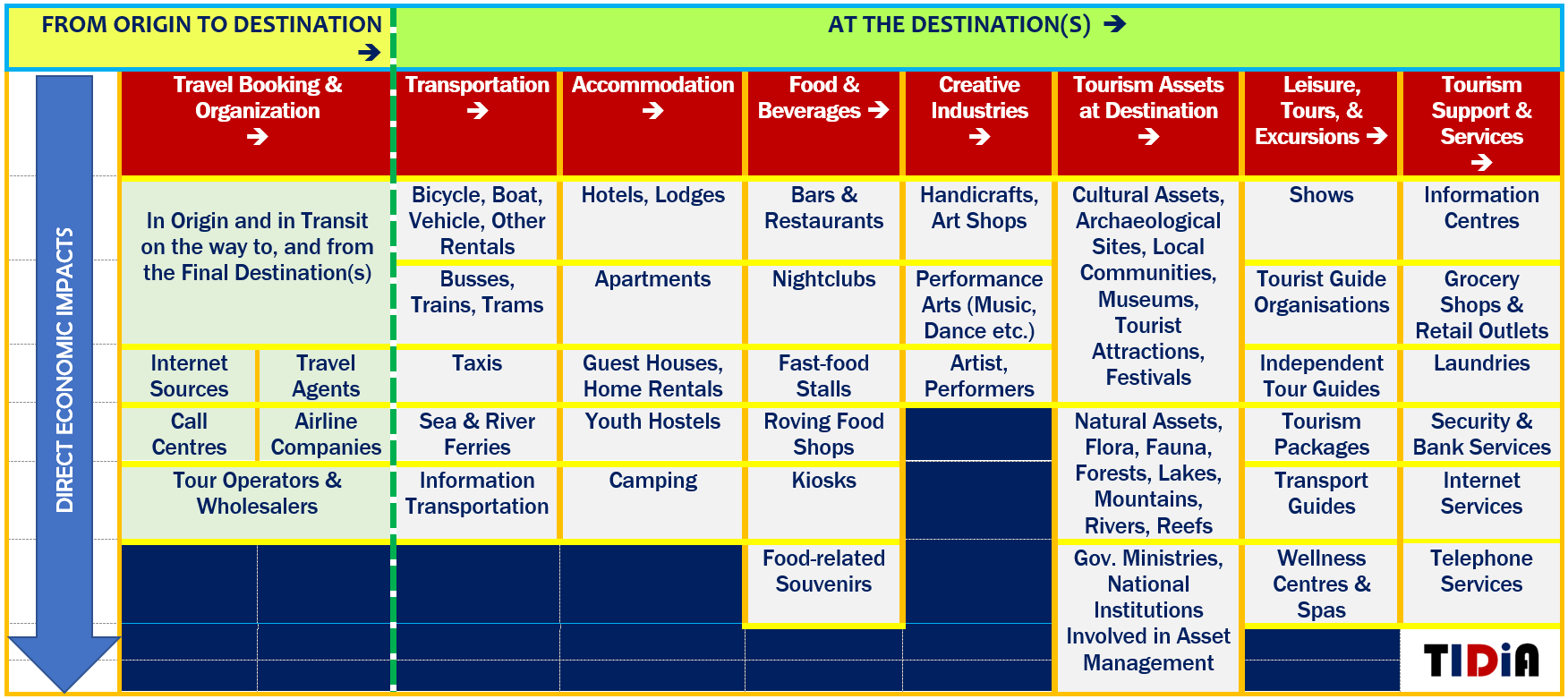
In terms of inclusiveness, tourism has a wide supply chain that includes transport providers, construction workers, agriculture producers, craftspeople, microbusinesses, and many others.
This gives the sector added value as a job creator, particularly in rural areas which may have few other employment options.
The Tourism Sector investment opportunities covers a wide diversity of Direct Businesses and Indirect Businesses.
Following table shows the vast variety of business opportunities directly related to tourism.
Tourism Value Chain Example
TOURISM DEVELOPMENT CASE STUDY – New Safari Lodge Example
All Tourism Developments will directly create various business opportunities for Micro-sized, Small-sized & Medium-sized Enterprises (MSMEs).
The TIDIA philosophy will be implemented ensure comprehensive economic inclusion opportunities, particularly for local supply chain MSMEs, with partnership agreements, commercial contracts and collaboration MOU’s etc.
Transportation – various opportunities including the following:
a] Day trips for game watching excursions into the National Park / Reserve/ Conservancy area,
b] Night drives into National Park / Reserve / Conservancy area,
c] Other sightseeing tours,
d] Shuttle services to Airport,
e] Shuttle services to other main attractions,
f] Photographic / Filming Safaris.
Curio Shopping for Souvenirs, Handicraft etc. [coordinate with traditional village & community]
Fresh produce supplies from the local community farmers, e.g.
a] Meat & poultry & eggs,
b] Fruit & vegetables,
c] Confectionary.
Supply of fresh flowers for hotel & events/functions,
Dry cleaning services for the hotel & conference centre,
Facilities management & maintenance works,
a] Supply labour, parts, equipment etc. for building maintenance & facilities management.
b] Provide IT systems & support services,
c] Provide audio & vision equipment for MICE, and other events etc.,
d] Provide telecommunications systems & support services,
FF&E [Furniture, Fixtures & Equipment], and various other services.
The above-mentioned excludes the other multiple downstream effects such as the support for the above-mentioned businesses.
CASE STUDY – New Safari Lodge Example
The Impact Investment opportunity of a particular Tourism Development, in a Community Conservation area, will Promote Economic Development, Social Development, and Environmental Protection.
Accordingly, the objectives of the particular tourism investment are to achieve the following:
| 1 | Economic Catalyst (Direct & Indirect) & Stimulus for further economic growth opportunities. |
| 2 | Inclusive & Sustainable Economic Impact for conservancy community & region. |
| 3 | Sustainable Social Impact, e.g. Job creation & Skills development, etc. |
| 4 | Business Opportunities for Local Micro-, Small-, Medium-sized Enterprises, e.g. Suppliers, etc. |
| 5 | Increased Opportunities for Discretionary Tourism Spending. |
| 6 | Establish Permanent Sustainable Infrastructure to attract more visitors. |
| 7 | Attract further Foreign Direct Investments & Local Investors [i.e. supply chain SMEs]. |
| 8 | Inclusive & Equitable capacity development / capacity building opportunities. |
| 9 | Establish resilient infrastructure for both tourism sector and agricultural sector (suppliers). |
CIRCULAR ECONOMY
Circular economy is a solution to protect and promote the health of the people, and to protect the environment.

Travel and tourism actors can act as powerful enablers of circularity, and benefit from shared circular value creation and value capture within relevant value chains.
TIDIA will endeavour to explore and realize all the possible Circular Economy investment opportunities on all new tourism development projects.
Formalising the Circular-economy model can also inspire further MSME developments (and investments), which collectively will kindle further micro-economic growth activities.
RATIONALE & BENEFITS
Tourism businesses, hotels and restaurants should aim to produce zero waste because this can already improve the profitability, and can increase the chances to become financially sustainable.
Capacity building with all the Stakeholders (MSMEs etc.) regarding the Circular Economy will create the awareness about the Holistic Economic Model applicable to tourism developments (and investments) for business optimization (and profitability) at the micro, meso, macro levels in the tourism sector.
All Stakeholders in the tourism sector can embrace concepts such as (a) “deep cooperation”, (b) “value co-creation”, and (c) “systems optimization”.
Back to Home Page: Home
 TIDiA - TOURISM & HOTEL DEVELOPMENTS & INVESTMENTS in AFRICA